
FINCH
A personal AI investing assistant built on your portfolio
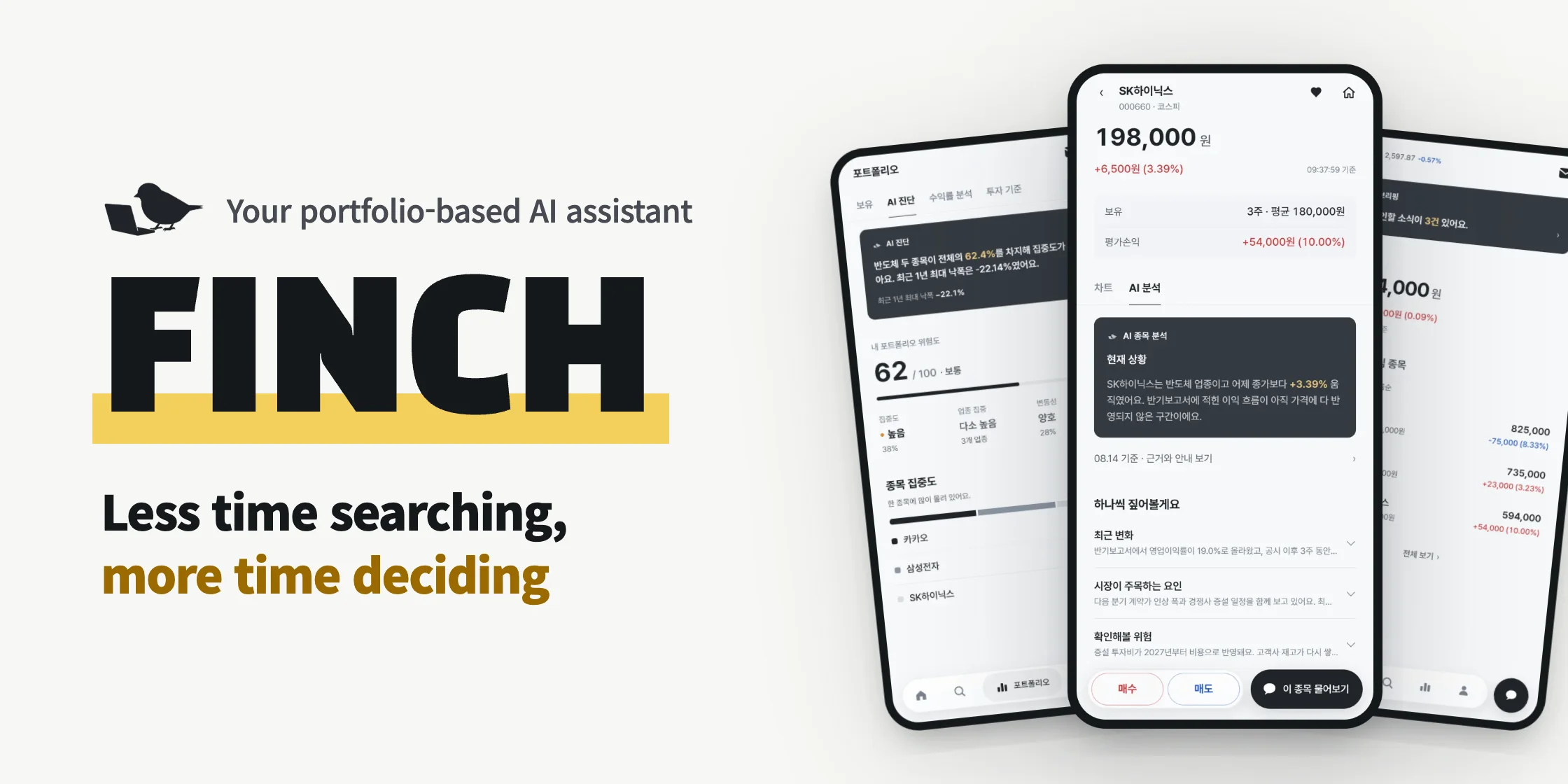
Screens
Overview
- Period
- Aug – Sep 2026 (6 weeks)
- Team
- 5 people
- Role
- AI lead
The problem
Prices, news and filings in stock apps are the same for everyone, so you have to work out what they mean for your own portfolio. The goal: personalized information based on your holdings and trades, without the LLM making up numbers or giving investment advice.
The approach
- 01Numbers come from a calculation engineReturns, weights and P&L are computed by an engine. The AI writes sentences with markers where those values go.
- 02Answers are checked before they go outTen checks cover numbers, sources and buy/sell advice. A failed answer is regenerated, and dropped if it fails again.
- 03The AI only reads account dataOnly the backend changes account data. The AI uses a read-only internal API.
- 04Answers show their sourcesNews and filings are collected daily, and the ones used in an answer are attached as footnotes.
Architecture
- 01Separation of dutiesNumbers and risk calls = Kotlin engine; explanation = LLM
- 02Single ledgerBalances and P&L are computed only from deposit and trade records
- 03Data collectionCalls focused on held, watched and recently viewed stocks
User scenario
- 01User flowSign up → explore → paper trading → portfolio → ask the AI
- 02System flowPrice collection → ledger → calculation engine → LLM explanation
- 03Separation of dutiesThe engine decides numbers and risk, the LLM explains — the AI never changes the ledger
My work
- 01Number substitutionThe LLM writes only allowed keys and the server fills in engine values, so no uncomputed number can reach an answer.The LLM writes allowed keys like {{return_005930}}; the server substitutes engine values (+2.48%) · responses split into text/number segments
- 02Ten output checksNumbers, sources and banned phrases are checked; a failing answer is regenerated with the reason attached and blocked if it fails again.Raw numbers · engine mismatch · citation integrity · banned phrases · schema, and more
- 03Tool-using chat agentPicks the lookup tools a question needs (account, returns, prices, news, filings) and answers only from what they return.Tool selection → narration · 7 tools in parallel, max 3 turns / 12 calls · job queue (Postgres SKIP LOCKED)
- 04News and filing collection and searchScheduled collection of news, filings and prices, searched as evidence for answers and the daily briefing.Naver News · DART filings → chunking · embeddings (text-embedding-3-small) → pgvector + lexical search, RRF fusion
- 05Test-driven developmentChecks, number substitution and tool calls were defined as tests first, then implemented. Golden tests on a fixed portfolio catch calculation regressions.pytest · golden tests · 708 tests
Why these tools
ToolProblemRole
numpy · pandasErrors in financial figures generated by the LLMReturns and risk calls fixed by deterministic computation
LLM APICost of resending the full prompt on every requestCached fixed prefix; only the explanation is generated
FastAPIExposing the AI server would break the auth boundaryInternal calls only, behind the backend
PostgreSQLPrice and stock data depended on the backendLoaded directly into a DB owned by the AI part
pydantic-settingsDevelopment blocked until the backend ledger API was readyOne setting switches between seed data and the backend ledger
Improvements
- 01Answers that only said "could not be confirmed"Found and fixed the root cause: depending on how the account was read, numbers never reached the AI.
- 02Slow chat answersSwitched models, turned off reasoning in the tool-picking step and had tools called together to cut the wait.
- 03Guards blocking good answersCounted why answers were blocked in production and fixed the top cause: sentences split wrongly around footnotes.
- 04A polluted experimentFailed responses left in the cache were hiding the A/B comparison; experiments now bypass the cache.